
Play with Petals
COMPOSE WITH COLOR, TEXTURE, AND BLOOM.
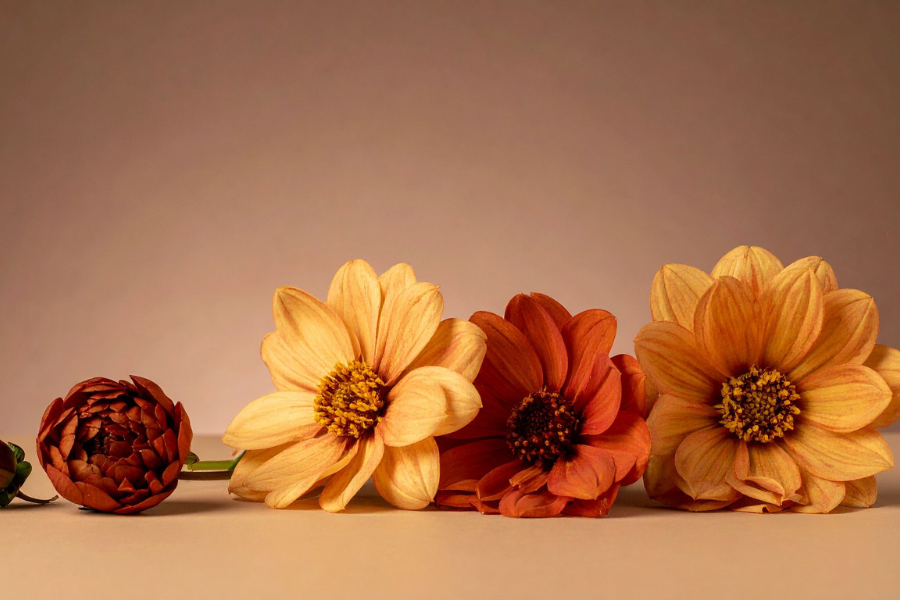
Color, texture, and form come together one stem at a time.
Flowers make color tangible.
A cluster of marigolds brings warmth. Dahlias add depth. Mums hold their shape in dense layers. Grasses, seed pods, branches, and leaves introduce line, movement, and texture.
Together, they become a living palette of color, texture, and form.
Visit a farmers’ market, flower shop, garden center, or local grower and choose a handful of seasonal stems. Take a floral design or ikebana class when you want guidance, or begin with a simple bouquet and see what happens in your hands.
This moment invites you to create with the season in bloom.
Start by looking closely.
Notice color, proportion, shape, texture, and how one stem can bring another into sharper focus.
Trim slowly. Turn the vessel. Remove a stem. Add one back. Let the arrangement change as you work.
You might build around one dramatic bloom, repeat a single color, mix soft petals with rougher textures, or let branches and grasses give the arrangement more movement.
A small arrangement can be just as expressive as a full bouquet.
One stem in the right vessel may be enough.
The pleasure is in seeing color, texture, and form find their place together.
This moment may be lived privately or shared with others.
THE PALETTE // SEASONAL FORM
Work with color, line, texture, proportion, vessel, and movement. Let the arrangement take shape one choice at a time.
A seasonal selection
Choose blooms, branches, grasses, seed pods, foliage, or other natural materials that reflect the season.
A focal bloom
Begin with one flower or element that draws your attention and let the rest of the arrangement build around it.
Color in layers
Repeat one hue, explore contrast, or combine several tones from the same family.
Texture in contrast
Pair soft petals with grasses, woody stems, sculptural branches, or seed heads to add dimension.
A vessel with character
Use a vase, pitcher, jar, bowl, bottle, or another container whose shape influences the arrangement.
A little asymmetry
Let some stems sit higher, lean outward, or fall loosely. The arrangement does not have to be perfectly balanced to feel composed.
A lasting bloom
Press or dry one bloom, petal, or stem from the arrangement and let it become a small record of the season.
REFLECTION
Which color, shape, or texture drew your attention most as you arranged the flowers?
What changed when you began composing with the stems instead of simply placing them in a vase?
THE EVOLUTION // LIVING COMPOSITION
Let floral arranging become another way of noticing the season as it changes.
Return to the market, garden, or flower shop and see what appears next.
Early autumn may bring one palette.
Later weeks may introduce deeper tones, dried grasses, branches, pods, and seed heads.
With each arrangement, you begin to notice more.
Which vessels suit certain shapes.
Which colors you tend to repeat.
How a single branch can alter the balance.
How space between stems matters as much as the stems themselves.
Over time, arranging becomes less about following a formula and more about developing an eye for composition.
The materials change.
Your way of seeing them continues to take shape.